The Ordeal of Anusuya and the Conduct of Brahma, Vishnu, Shiva
Tales from the Puranas / The Ordeal of Anusuya and the Conduct of Brahma, Vishnu, Shiva
The Ordeal of Anusuya and the Conduct of Brahma, Vishnu, Shiva
A Controversial Account from the Bhavishya Purana: The Ordeal of Anusuya and the Conduct of Brahma, Vishnu, and Shiva
The Bhavishya Purana contains several narratives that sharply diverge from later idealised portrayals of Hindu deities. One such lesser-discussed but deeply provocative episode involves sage Atri, his wife Anusuya, and the actions of Brahma, Vishnu, and Shiva. The account, as preserved in the Bhavishya Purana and reflected in the uploaded text, raises serious moral and theological questions regarding the character and conduct of these deities.
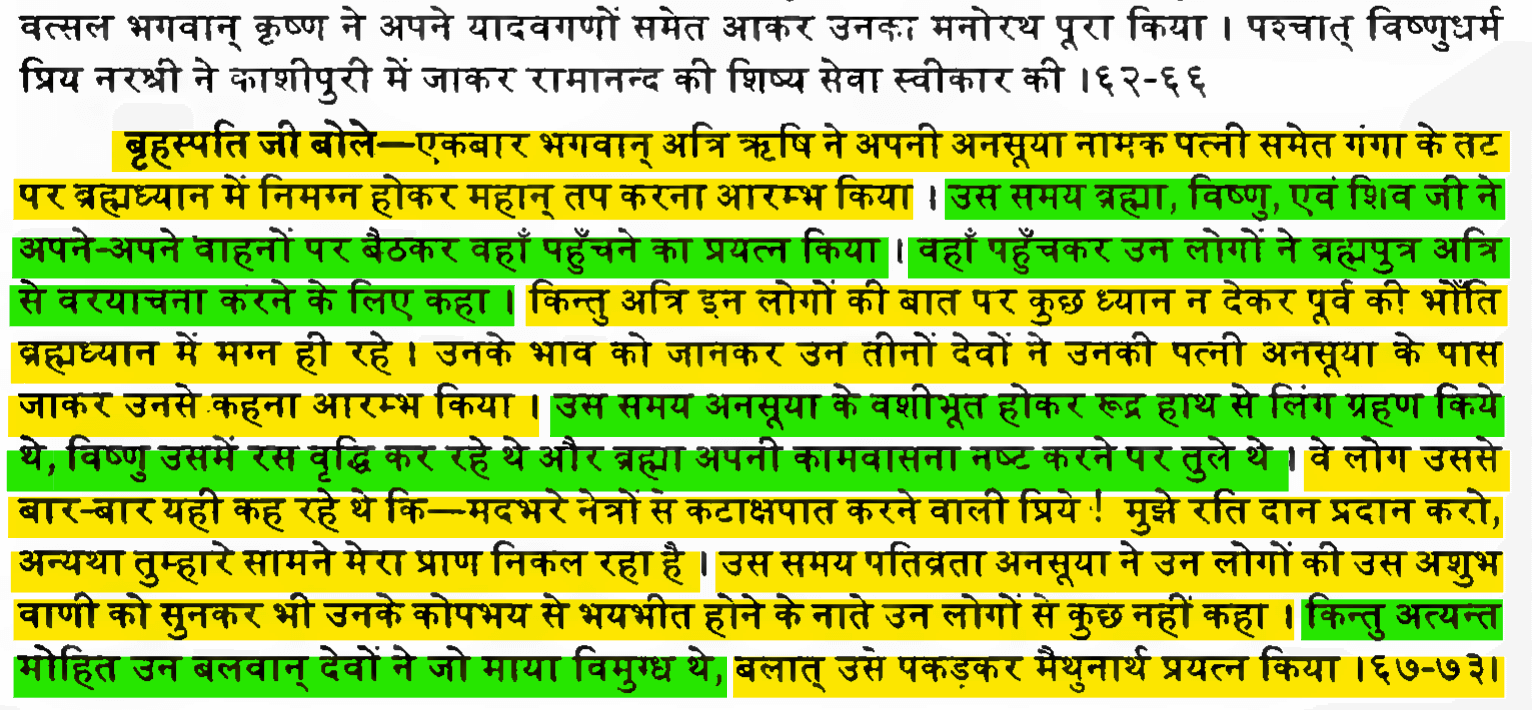
English Translation - Bhavishya Puran
Brihaspati said: Once, Sage Atri, along with his wife named Anasuya, began intense penance on the banks of the river Ganga, being deeply absorbed in meditation on Brahm.
At that time, Brahma, Vishnu, and Shiva, mounting their respective vehicles, attempted to reach that place.
After arriving there, they requested Sage Atri for an audience. However, Atri paid no attention to their words and remained absorbed in Brahm-meditation as before.
Understanding his mental state, the three deities went to his wife Anasuya and began speaking to her.
At that time, having come under the influence of Anasuya, Shiva accepted his phallus with one hand, Vishnu was engaging in sensual desire toward her, and Brahma was intent on satisfying his lust.
Again and again they said to her: “O beloved with beautiful eyes that cast seductive glances! Grant us sexual pleasure, otherwise, right before you, our lives will depart.”
At that time, the chaste Anasuya, even after hearing those inauspicious words of theirs, did not say anything to them, being frightened by their improper conduct.
However, those boon-seeking gods, who were acting against righteousness and through illusion, forcefully seized her and attempted sexual intercourse.
The Setting: Atri’s Austerity and Anusuya’s Pativrata
According to the text, sage Atri undertakes intense austerities along with his wife Anusuya on the banks of the Ganga. Anusuya is described as a supremely chaste and virtuous woman, deeply devoted to her husband and unwavering in her conduct. Her pativrata (marital fidelity and moral strength) is portrayed as so powerful that it becomes renowned even among the gods.
This fame, however, does not inspire reverence—rather, it provokes attention driven by desire.
The Arrival of the Trimurti
The Bhavishya Purana narrates that Brahma, Vishnu, and Shiva, each mounting their respective vehicles, arrive at Atri’s hermitage when the sage is immersed in deep meditation. Finding Anusuya alone, they approach her not as protectors of dharma, but as petitioners driven by lust.
The text explicitly states that they begin to verbally pressure Anusuya, making indecent demands and repeatedly asking her for sexual gratification. The language used in the narrative is not symbolic—it clearly conveys sexual intent and coercion.
They plead, threaten, and emotionally manipulate her, asserting that their lives will end if she does not comply. Such statements frame the encounter not as a test of virtue, but as moral blackmail.
Anusuya’s Response: Fear, Restraint, and Resistance
Anusuya, described as deeply frightened yet composed, does not consent. She neither reciprocates desire nor encourages them. Instead, the text emphasizes her inner restraint, silence, and adherence to virtue despite fear.
Crucially, she does not triumph through trickery or dominance in this version. Rather, she survives the ordeal by enduring it without yielding, underscoring her moral superiority in contrast to the gods’ behavior.
Eventually, unable to succeed, the three gods withdraw.
Ethical and Theological Implications
This account presents several unsettling implications:
- The gods are shown as desire-driven, lacking self-control.
- A lone woman is approached collectively by three powerful male figures.
- The encounter relies on coercion rather than consent.
- The narrative does not justify their actions as divine play (leela) or cosmic necessity.
From a theological standpoint, this challenges the notion of Brahma, Vishnu, and Shiva as morally perfect or omniscient beings. A truly supreme and liberated entity would not:
- Be overcome by lust
- Pressure a chaste woman
- Exploit power asymmetry
- Act in the absence of righteousness
Instead, the Bhavishya Purana presents them as embodied, fallible beings, subject to desire, impulse, and ethical failure.
Contrast with Later Sanitised Versions
Later Puranic retellings and popular narratives often:
- Remove explicit sexual language
- Reframe the event as a “test”
- Shift blame away from the gods
- Portray Anusuya’s ordeal as divine validation rather than victimisation
However, the Bhavishya Purana’s version does not support such reinterpretations. The text itself preserves the raw moral tension and leaves the gods’ conduct exposed rather than absolved.
Conclusion
The Bhavishya Purana’s account of Anusuya and the Trimurti is not merely an obscure myth—it is a theological critique embedded within scripture itself. It elevates human virtue above divine authority and exposes the limitations of gods who are often later proclaimed as supreme, flawless, and eternal.
This narrative compels the reader to ask a difficult but necessary question: If gods can succumb to lust, coercion, and moral weakness, can they truly be regarded as the ultimate source of dharma?
In this sense, the Bhavishya Purana stands not as blind praise, but as an uncomfortable mirror held up to divinity itself.
Ref:
← The Tulsi–Vishnu Narrative King Parikshit and the Five Abodes of Kali Yuga →